
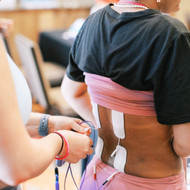
Where To Place TENS Pads For Labour Pain Relief
Posted by Lisa Akins on 31st Jul 2026
Getting the pad placement right is what makes a TENS machine actually work. Put the pads in the wrong spot and you'll feel the buzz, but you won't get the pain relief. Here's where they go, and why it matters.
Why placement matters
A TENS machine works by targeting specific nerve pathways that carry pain signals from the uterus and cervix to the brain. Those pathways run through particular points on your lower back.
Midwives suggest practising the placement before labour starts, rather than working it out for the first time between contractions. Remember that if you have purchased your TENS, it can not be used for general pain before the 37th week of labour when your baby is full term.
The upper pads
Place the first pair of pads either side of your spine, roughly at bra strap level. NHS guidance on TENS in labour puts them about an inch or two either side of the spine, not directly on it.
Keep the top edge of each pad level with where a bra strap would sit. This positions them over the nerve roots that carry signals from the upper part of the uterus.
The lower pads
The second pair goes lower down, roughly where the small dimples sit just above your bottom, sometimes called the sacral dimples. Again, place them either side of the spine rather than on it.
NHS Forth Valley's guidance describes this as roughly the top of your knicker line. If you're unsure about where to place them on your Elle TENS unit, a midwife can check the spot at an antenatal appointment.
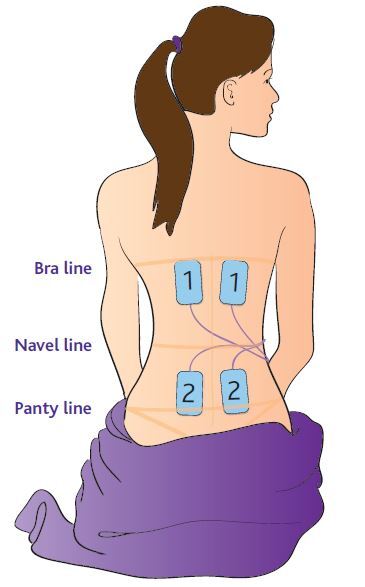
Cluett E. (1994) SRN RM ADM PGCEA. Analgesia in Labour: A review of the TENS method. Professional Care of Mother and Child. Mar;4 (2): 50-2.
Getting the spacing right
A few points are worth keeping in mind when placing the pads:
- Leave a small gap either side of the spine itself. Placing a pad directly over the spine may not reach the right nerve roots.
- Keep the two pairs a reasonable distance apart, one at bra strap level and one lower down, rather than clustering them close together.
- Check the machine is switched off before you attach or reposition any pads.
- Turn each dial up slowly once the pads are on, until you feel a mild tingling rather than anything sharp.
- It's best not to move the pads whilst the TENS machine is still on.
Letting someone else help
Placing the pads on your own back is awkward, especially once contractions are underway. A birth partner can do this for you, and it's worth practising together beforehand so it's familiar rather than fiddly on the day. You can try 2 pads on your forearm to get used to the sensation and the settings on the device.
Once the pads are on, though, only you should control the dials and the Boost Button. You're the only one who can feel how strong the current needs to be.
Adjusting as labour progresses
The pads don't need to move once they're in the right spot, but the settings will. Start on the lowest intensity and increase it gradually as contractions strengthen. Use the Boost Button during each contraction, then release it once the contraction passes, so the machine drops back to its gentler background setting.
If the pads lift or lose their stick as labour goes on, a spare set of replacement pads is worth having in your bag. Skin becomes damp during labour, and adhesive that held well in a calm antenatal class doesn't always hold the same way hours later. It's also worth checking why using the correct electrodes matters, since not every pad on the market is designed to fit your machine properly.
Where not to place the pads
Stick to the two positions on the lower back described above rather than experimenting with other spots, since these are the ones the machine's boost function and settings are designed around. A few areas to avoid altogether:
- The front or sides of the neck
- The head
- Broken or irritated skin
- Any area that already feels numb
Getting ready before your due date
Most of this is easier with a bit of practice. If you're hiring an Elle TENS for labour, it's worth trying the placement out together with your birth partner in the weeks beforehand, so you're not reading the instructions for the first time mid contraction. The same goes if you're planning to buy a machine to keep. Our FAQs cover common questions on getting set up, and your midwife can check your placement at any antenatal appointment if you'd rather have it confirmed in person.