
What Is A Maternity TENS Machine And How Does It Work?
Posted by Lisa Akins on 27th Jul 2026
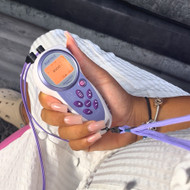
A maternity TENS machine is a small handheld device that sends gentle electrical pulses through the skin. It works through sticky pads placed on your lower back. TENS stands for Transcutaneous Electrical Nerve Stimulation.
Midwives have recommended it for decades. It's a drug free option for coping with labour pain, especially loved by mums in early labour when at home. The NHS lists TENS machines among the standard pain relief choices offered in UK maternity care.
The device is battery powered and roughly the size of a smartphone. You clip it to your waistband or hang it from your neck with a supplied lanyard. This means you're free to move and change position freely. That mobility matters. Staying upright and active often helps labour progress, and unlike some pain relief options, a TENS machine doesn't tie you to a bed or a wall socket.
How the electrical pulses ease discomfort
Two theories explain what's happening under the skin.
- The first is Gate Control Theory. Your spinal cord acts as a roadway for pain signals travelling from the uterus to the brain. The tingling sensation from the TENS Machine gives the nerves something else to carry. This competing signal crowds out some of the pain messages before they reach the brain. Think of it as rubbing a bumped elbow. The rubbing doesn't undo the knock, but it changes what your brain pays attention to.
- The second is endorphin release. This setting feels like a pulsing heartbeat sensation. As the pulses continue at a low and steady pace, the body responds by producing more of its own natural pain relieving hormones. This effect builds gradually. It's why midwives generally suggest starting the machine as soon as contractions begin, rather than waiting until they're intense.
A maternity specific TENS unit differs from the ones used for back pain or sports injuries in one key way: it has a Boost Button. Press it during a contraction, and the machine switches from a low pulsing rhythm to a stronger, continuous one that is specifically designed to combat contraction pain. Release it once the contraction passes, and it reverts back to the gentle endorphin release setting. You respond to the rhythm of labour, rather than sitting on one fixed intensity throughout.
Where the pads go
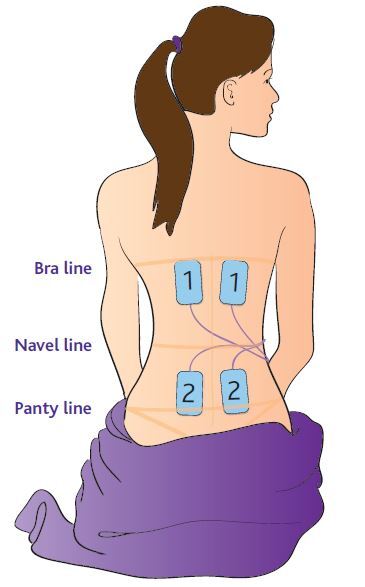
The four electrode pads sit either side of the spine. Two go roughly between the shoulder blades, and two lower down near the small of the back. This positions them over the nerve pathways that carry sensation from the uterus and cervix.
Placement matters. Pads that drift too far from the spine won't reach the right nerve roots.
Check the positioning against the instructions that come with the machine. Ask a midwife to check it at an antenatal appointment. Use replacement pads designed for the machine, since generic ones don't always fit the same contact points and may not be compatible or safe to use with your TENS machine.
When to start using it
Most guidance points to early labour, once contractions are noticeable but not yet close together. That gives the endorphin response time to build before things intensify.
TENS is one of the most supportive pain management tools mums can have during early (latent) labour, especially when at home. While options such as paracetamol and other comfort measures may provide some relief, many mums find they are not enough as contractions become stronger. A TENS machine offers a drug-free, easy-to-use way to help manage early labour discomfort, providing reassurance, control and support during those important first stages of labour. It isn't designed to be switched on the moment labour begins and then forgotten. As contractions strengthen, you'll likely increase the intensity and lean on the Boost Button more often.
What to expect from TENS
Research on TENS in labour is very positive. A national survey of maternity units across England found strong support for TENS among midwives, and most women who try it say they'd definitely use it again. Some studies show women report less severe pain. Others suggest much of the benefit comes from the distraction and sense of control the machine offers.
What seems consistent is that a lot of women find it genuinely helpful, particularly in early labour, and it carries none of the side effects associated with pharmacological pain relief. It isn't a guarantee that labour will be pain-free. Many women combine it with other pain relief, such as gas and air or pethidine, since TENS doesn't interfere with either. Most women use it alongside other coping techniques, such as breathing, movement or a birth pool.
TENS machines are considered safe for use once labour has properly begun. They cannot be used to manage general pregnancy discomfort in earlier weeks, since the use of a TENS machine before the baby is full term could bring on labour.
If having a water birth and using a TENS machine, the pads will need to come off before you get into a birthing pool or bath.
NHS guidance notes a TENS machine may not be suitable for anyone with epilepsy, a pacemaker or another electrical implant, so it's worth mentioning this to your midwife if it applies to you.
Getting ready before your due date
Make sure to read through the instructions in good time before going into labour. It is safe to try the TENS machine before going into labour. Many mums-to-be purchase a practice set of electrodes specifically for this reason in order to save a fresh set for the big day. Get familiar with the boost button before your due date arrives, rather than working it out for the first time during a contraction.
Maternity TENS machines are available to both hire or purchase. Many mums-to-be prefer to purchase particularly if you're planning more than one pregnancy and because they can be used to treat post natal pain, such as breast feeding pains and period pains. Our FAQs cover most of the practical questions that arise before labour starts.
An Elle TENS machine, like others of its kind, won't take labour pain away entirely. What it offers is a way to work with your body's own pain relief systems, adding control over the intensity as things change, and the freedom to keep moving while you do it.