
Should You Use A Birth Comb Or A TENS Machine For Labour?
Posted by Lisa Akins on 17th Sep 2026
Two of the most common drug free options for coping with labour pain couldn't look more different. One is a small battery powered device with pads that stick to your lower back. The other is a piece of wood you grip in your fist. Both turn up in hospital bags and birth plans across the UK, and both come with genuine reasons behind them. Here's what each one actually does, and what the research says about whether it works.
How a TENS machine works during labour
An Elle TENS machine sends a low level electrical current through four self adhesive pads placed on your lower back, each 40mm by 100mm, larger than the pads on many conventional TENS machines, and controlled by a small handheld unit you hold onto through contractions. Your spinal cord acts as a route for pain messages heading from the uterus to the brain, and the tingling from the pads gives the nerves a second signal to carry alongside them, crowding out some of the pain before it registers. Every machine comes with a boost button. Press it as a contraction peaks and it sends a stronger surge of power right when you need it most.
A second theory sits behind the same device. Run at a steady, low pace between contractions, TENS is thought to prompt the body to release more of its own natural pain relieving hormones, an effect that builds over the hours you wear it rather than kicking in straight away. Elle TENS tunes this delivery through what it calls the Burst mode aiming the pulse pattern more precisely at that endorphin response.
How a birth comb works during labour
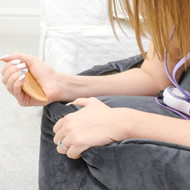
A birth comb works on a much smaller scale. You hold it in your fist with the teeth pressed into the centre of your palm, at a point acupuncture and acupressure practitioners call Laogong, and squeeze through each contraction, swapping hands when one gets sore. The Acu-comb version of this is made from peach wood with rounded teeth.
Two ideas are usually offered for why this helps. The first is acupressure: pressing on this point is thought to ease pain and anxiety in the same way pressure on other points does in acupuncture. The second is distraction paired with gate control theory, the same mechanism behind TENS. Your hand becomes something else to think about, so contraction pain has to compete for attention rather than arriving unopposed
A comb needs no batteries and no set up. You can start using one the moment contractions begin and put it down the moment you don't want it any more.
What the evidence says about each
The two have very different research behind them. Our dedicated clinical studies page sets out several trials with real numbers behind them. In one of 1,041 women, 97% of pregnant mums rated their TENS effective for labour pain relief , with fewer than 2% reporting fair or no relief. A separate trial of 272 women found 80% would recommend TENS and 72% said they'd use it again in a future labour, with pain scores dropping significantly within two hours of starting it. A randomised trial found TENS reduced pain and postponed the need for pharmacological pain relief compared with a control group, with 74% of women satisfied and every woman in that trial saying she'd choose the method again. The NCT found women using TENS were less likely to describe their pain as severe.
A birth comb doesn't have that kind of trial behind it. No published study has tested a comb on its own. What support exists comes from a Cochrane review of manual acupressure, applied by a practitioner's hands at points including one on the back of the hand and one on the lower leg. It found that acupressure probably eases pain intensity slightly compared with the mix of control treatments used across the trials as a whole. Most of what's written about combs is experience rather than evidence: women who found the sensation a helpful thing to focus on, alongside breathing and movement.
Practical differences worth knowing
A few things separate the two beyond how they're meant to work. TENS is a piece of electrical equipment, so it comes off before you get into a birthing pool or bath. The NHS is clear that TENS and water don't mix, and taking it off beforehand won't stop you having a water birth. A comb has no such restriction. It's just wood, so it goes wherever you do, the pool included.
Getting a TENS machine ready takes a little more preparation, finding the right pad placement and checking the battery before labour starts in earnest. A comb needs none of that. Pick it up and squeeze it. That makes it a reasonable thing to keep in a coat pocket or hospital bag as a backup for the gaps before a TENS machine is out and running.
A birth comb's job ends the moment labour does. Our Elle TENS models, like the Elle TENS Plus, keep going afterwards, with general pain and pelvic floor modes for afterbirth aches and postnatal recovery.
Deciding which to try first
Neither one is a promise of pain free labour, and treating either that way sets up disappointment on the day. A TENS machine carries a larger body of published research behind it, plus a boost button for the moments contractions peak, and it works best when you start using it early, before labour is properly under way. A birth comb won't replace that evidence base, but it costs very little to try, needs no set up and works in situations a TENS machine can't.
Many mums choose to use both a labour come and TENS machine simultaneously during their labour.The FAQs cover more on getting started with either one.